
 New York had Paradise Garage, the celebrated and somewhat legendary dancehall as soundtracked by Larry Levan. Chicago had The Warehouse, the birthplace of house music – and essentially all forms of electronic music. And in 1991 in the north of England, the shining beacon of Leeds to be specific, a similar musical movement was starting. A movement that would stick two fingers up at its peers, and would remain “two steps further than any other fucker” to this very day. This movement was Back To Basics.
Born from an ethos that rebelled against the rave scene in the UK in the early-1990s, Back To Basics has spent the last 22 years championing true house music, officially making it the UK’s longest-running club night – and the longest-running house night in the world. Over the years Back To Basics has seen its fair share of ups, downs, changes and tragedies, yet one thing that still remains with Back To Basics since its inception is its failure to follow trends or bow down to fads.
While Daft Punk, Basement Jaxx, Groove Armada and many more have all played under its banner, its Back To Basics’ contribution to the city of Leeds itself that remains its greatest achievement. While Leeds remains one of the most vibrant cities in the UK, the club scene was remarkably different when Back To Basics first opened its doors. As Back To Basics pioneered a completely unique movement this helped put Leeds on the map as both a city of culture and, with Dave Beer’s vital involvement, one of the greatest cities in the UK for electronic music.
Dave Beer has proven himself a legend in Leeds and beyond. As co-founder of Back To Basics he has helped to create a movement that rivals punk in its rebellious attitude, while also helping to manage the careers of Ralph Lawson, Laura Jones and Tristan Da Cunha. As head of Back To Basics Recordings Dave would release some of the biggest-selling mix CDs of the ’90s from the likes of Andrew Weatherall and Derrick Carter. As an artist Dave has produced memorable, politically charged flyer artwork that continues to inspire and agitate in equal measure. Yet as a proud resident of Leeds he is simply ‘a purveyor of good times’.
While Back To Basics remains unrivalled for its achievements over the years, 2014 will signify its inaugural venture in to the woods of Anglesey for Gottwood Festival. Here we chat with Dave about his legacy, Thatcher and his upcoming documentary film.
Back To Basics brought about a drastic change to not only the music scene in Leeds but to Leeds as a whole. How have you seen the city – or the perception of Leeds in terms of UK and music culture – change in this time?
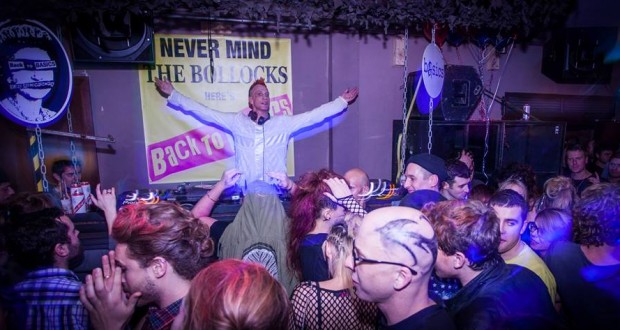
It’s crazy to think how different Leeds is today as when we started the club 22 years ago. There was no such thing as dance clubs, just a few mecca style clubs, pubs and a couple of kebab shops. The licensing laws then meant that everywhere shut at 2am. This was before ecstasy culture, so we saw a lot of drunken people on the streets fighting.
When we opened our doors in 1991 it was a backlash against the jaded rave scene and because there was nowhere in our area, we were travelling to clubs such as the Hacienda in Manchester and Venus in Nottingham or down to Fly-in in London. After the first year of B2B in ’92 all the top clubs in the country were in Leeds, as voted by ‘Mixmag’ and ‘DJ Mag’. There was B2B, Orbit, Hard Times, Up Yer Ronson, Vague, Arc and a few more to mention. People were travelling from all over the country to come to Leeds and still are to this day. We created a monster. On most nights there is a choice of venue all hosting some of the biggest names in dance music.
I jokingly say it’s because in the name Leeds there’s LSD and two ‘E’s, so obviously it would be the party capital.
At what point did you realise how much a seemingly simple idea in Back To Basics could have such an impact? And how did it affect your plans for the night?
When we opened the club there was nowhere in our area catering for the style of music we were into. We started on one floor in a gay club and we thought it might get six months at best. But week by week the crowds were doubling and within six months we were turning away hundreds. By then we had moved the club onto three floors and the capacity was 1000. The plan has always been that there is no plan, B2B has always been a way of life.
What effect would taking things ‘Back To Basics’ have today? Can such a cultural change come from a movement like Back To Basics yet again? If so/not, why?
The scene is now pretty saturated. I think people would definitely appreciate a club going Back To Basics, in fact it’s what we do. Rather than always putting on big events we also do small ones to keep it more intimate and exciting.
Some of the greatest musical movements have been born through struggle – for example Detroit techno and the city’s economic downturn and Disco, New York and gay liberation. Was there a ‘struggle’ in Leeds at the time you created Back To Basics, and if so how did that influence you in the beginning?
Yeah, there was a definite struggle in the early ’90s. There was big economic change and a recession through Thatcher’s government. We’d also just lived through the miners strike which hit the North heavily. There was a lot of unemployment, not to mention the Criminal Justice Bill, which was another government clamp down to stop people partying and to end the illegal acid house raves. So yeah, Basics was certainly born out of a struggle. “We had to fight for your right to party.”
Punk was a political movement, while house in the late ’80s and ’90s was famously apolitical. As someone who grew up around the punk movement – and having been affected by political changes in your lifetime, what was it about house music that represented that mentality?
Although I hate to say it, and I’m not belittling punk in any way as it meant so much to me, the punk movement has changed the world and the record industry for generations to come. However looking back punk only lasted a short time in comparison, almost like a fashion statement. It’s crazy to think most musical genres only last a decade. We had the ’50s, ’60s, ’70s, then the ’80s when acid house started, and it’s still going strong today three decades later.
What did you take from both the punk/house movements to create Back To Basics?
Acid house, like punk, had something for everybody. The feeling of doing something for yourself helped create music out of bedrooms, from council estates to recording studios, in a way acid house was even more illegal and made it exciting. The punk movement was there to go against the mainstream just like acid house. No young person wants to dance like their parents or do what they tell them to do; every youth movement gives young people a platform to rebel, and my god did we rebel in punk and in acid house. Long live the spirit of the young.
You were one of the youngest members to be chosen by the Leeds City Museum as it chronicled the cultural changes of Leeds over the years. Away from awards what do you think your legacy is within the city?
Besides being a young upstart that got under everyone’s noses by asking awkward questions to what is known as normal society, I’ve always seen myself as a purveyor of good times. It even said it in my passport as my occupation. I used to say I was a rebel without a clue. Without likening myself to James Dean who is a true legend, I’ve come to see myself as a rebel with a cause. I don’t know at what stage we became respectable and a part of society as a norm but I do see it as a privilege these days to have been of service, although I’m not too sure about being a museum artefact. I know I’m getting on a bit but it isn’t over until the fat lady sings as they say, however it’s always nice to be noticed for your endeavours.
You’ll be playing hosting duties at this year’s Gottwood Festival. How does Gottwood fit in with your ‘two steps further than any other fucker’ ethos, and what will you bring to the woods?
I only take B2B to places I have respect for or which excite me. One of my resident DJs – Tristan da Cunha, who will be appearing with us in 2014 – played Gottwood in 2012 and told me about the amazing time he had, and that the organisers are like-minded people who do it for the love and not just for the money. We hope to bring our special brand of fun and merriment to the event and dance like our life depended on it, just as we always do. I think it will be a meeting of kindred spirits, so I’m really looking forward to it.
What are you most looking forward to about being a part of Gottwood?
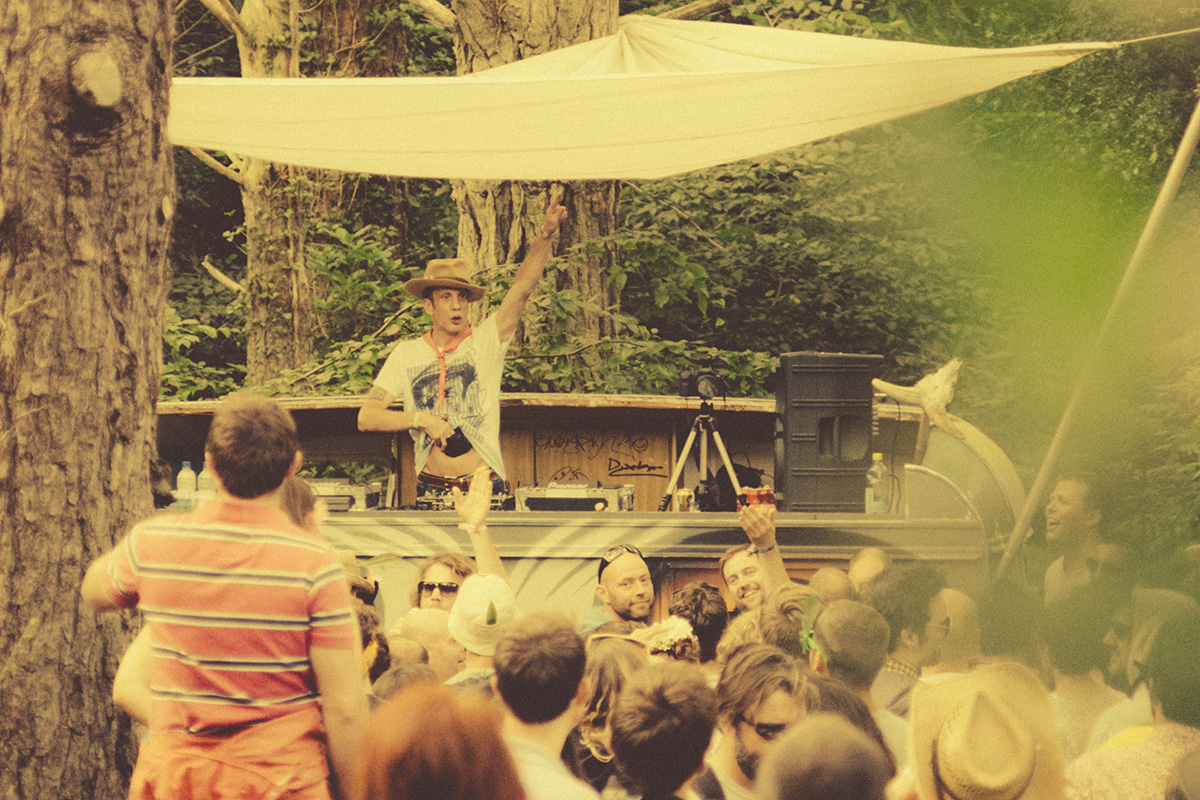
I’ve always been a big fan of partying in fields from my acid house days, and being a young man at the festivals. I’ve always attended Glastonbury since I was big enough to go. I love the fact there are new festivals to explore. This is my first time at Gottwood so I’m excited to be going somewhere new, set up my tipi, have a pow-wow with some other tribes and smoke a peace pipe or two…
Back To Basics is about to be immortalised in a film. How did the project come about, and what do you want to achieve with it?
The inception of the film came about by a young filmmaker Klaudia Staniek while she was filming at Leeds University. She was a regular at the club and came up with the idea to document what was going on as she had just moved to England and never quite seen anything like it. I first agreed to it as it was a small project, but after three years of filming and interviewing virtually every big name DJ, as well as the clubbers who had been through the doors, it’s become a full-length feature documentary. It’s picked up a lot of momentum and outside interest from the film industry, so it looks set to gain a worldwide release.
I’m not sure what my expectations are except it’s a beautiful thing to have it all recorded for posterity as something that can be looked back on in years to come, as we now look back on documentaries from past movements such as rock & roll, disco, punk, and so on. If anything it will be great to spread the word on what we’ve actually achieved, the part we’ve played in dance music and how we’ve always remained in the underground. I’ve been humbled and honoured by what people have had to say in the film about me and B2B and the impact it has had on their lives. It’s only when you see it on film that you look back and think ‘Wow, did we actually do that?’.
Furthermore will you be filming at Gottwood?
Yes we’ll be filming at the festival. At that stage we’ll be editing and rounding the film up with what we’re now up to with taking Basics around the world, and by going back to basics and dancing in fields once more where it once started. I’m really looking forward to the festival and adding our little bit of fun to what already looks to be an amazing event.
Back to Basics has just celebrated its 22nd birthday, over that time have you ever imagined Back To Basics coming to an end? Is there anything in particular you would still like to achieve? And in an ideal world how would you want for it to bow out?
The plan has always been that there is no plan – we didn’t expect to last six months, never mind 22 years. I’ve not really planned on ‘bowing out’ as such, as long as people want us to be here we’ll be here. However I do have aspirations of taking the club abroad and settling in the sun one day.
Name us five tracks that are significant to you and Back To Basics over the 22 years, and the story that goes with them.
Please not this question again, I’m really sorry but there are far too many tracks that mean so much to me for so many reasons. Tracks that are seminal to B2B such as ‘New Jersey Deep’ by Black Science Orchestra, ‘The Phantom’ Renegade Soundwave, ‘Baby Wants To Ride’ Jamie Principle, and one of my all time favourites from MK ‘Burning’. I could go on forever – there are so many tracks that mean so much. Basics has always been about the music. To quote another track, by Mr Tenaglia, ‘Music Is The Answer’.
If you were stranded in the woods which three items would you not be able to leave behind?
Well I was a boy scout so I’m always prepared, I even know how to build a Bivverwhack. As a seasoned festival-goer one should always have something warm to wear, waterproofs, wellies, and it’s always nice to have somebody to cuddle up with. Hopefully I wont be getting stuck in the woods again as you guys will be looking after me. I don’t need boutique camping but a tent always come in handy.
Words by: Jack Needham